
LTL vs LCL Freight Explained
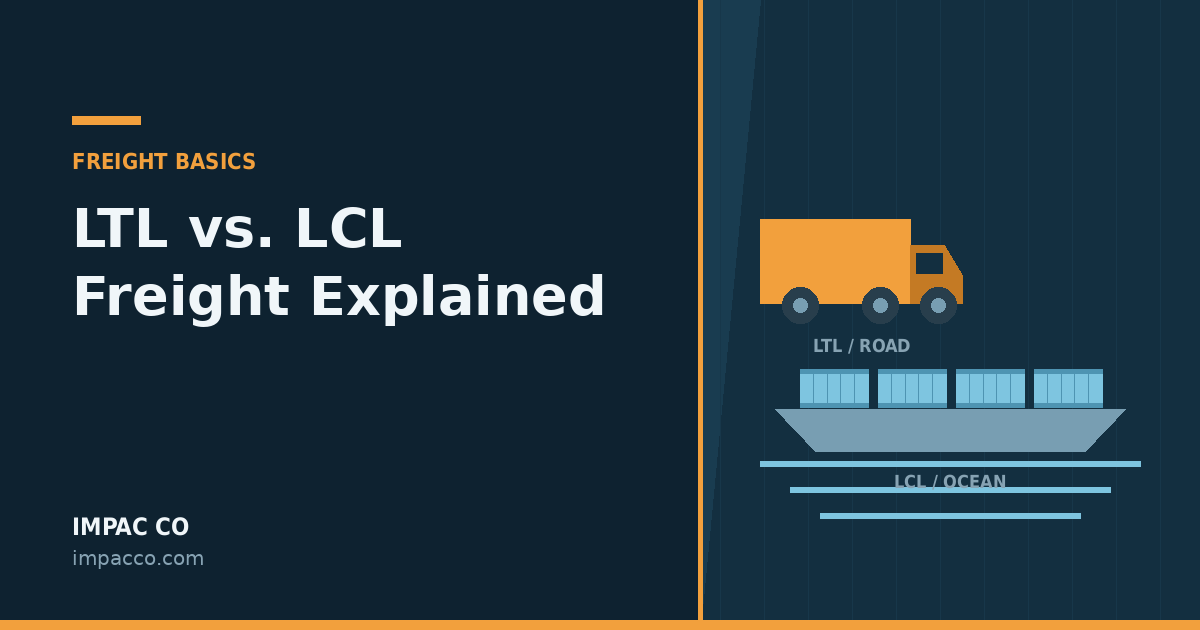
When your shipment is too small for a full truck or container, two terms come up: LTL and LCL. They’re similar ideas in different transport modes. Here’s how they differ and when each fits building-material freight. LTL (less than truckload) shares space on a truck with other shippers’ freight, while LCL (less than container load) shares space in an ocean container. Both let you pay only for the space you use instead of an entire truck or container – ideal for freight roughly between 150 and 15,000 pounds.What is LTL?
LTL stands for “less than truckload.” Your freight travels on a truck alongside shipments from other customers, and you pay for the portion you use. It’s the cost-effective option for road freight that doesn’t need a whole trailer.What is LCL?
LCL stands for “less than container load.” It’s the ocean equivalent of LTL: your materials share a shipping container with other shippers’ freight. For building materials bound for Alaska or Hawaii by sea, LCL is the consolidation method that keeps smaller orders affordable.When to use each for building materials
The mode usually decides it: LTL for road segments, LCL for the ocean crossing – and a single shipment to Alaska or Hawaii may use both. Either way, consolidation suits freight roughly between 150 and 15,000 pounds. Above that, a full container load is typically more economical. Impacco handles LTL drop-off at the dock and LCL consolidation, and can advise the best mix for your order.Frequently Asked Questions
Can one shipment use both LTL and LCL?
Yes – materials may move by LTL on the road and LCL across the ocean as part of one journey.
What size freight suits LTL/LCL?
Roughly 150 to 15,000 pounds. Larger volumes are usually cheaper as a full container load.
Do you offer dock drop-off?
Yes – Impacco can drop LTL freight at the dock, and use Alaska Air Cargo for urgent needs.
Related Guides

Related posts
How Long Does It Take to Ship Building Materials to Alaska?
Timing is one of the most important factors in any Alaska build, because materia
Container vs Platform Loading: The Difference
In freight and construction logistics, “container loading” and “platform l
When to Order Building Materials for Alaska?
On an Alaska project, ordering materials too late is one of the most expensive m